Big Five vs Myers-Briggs: Which One Should You Trust?
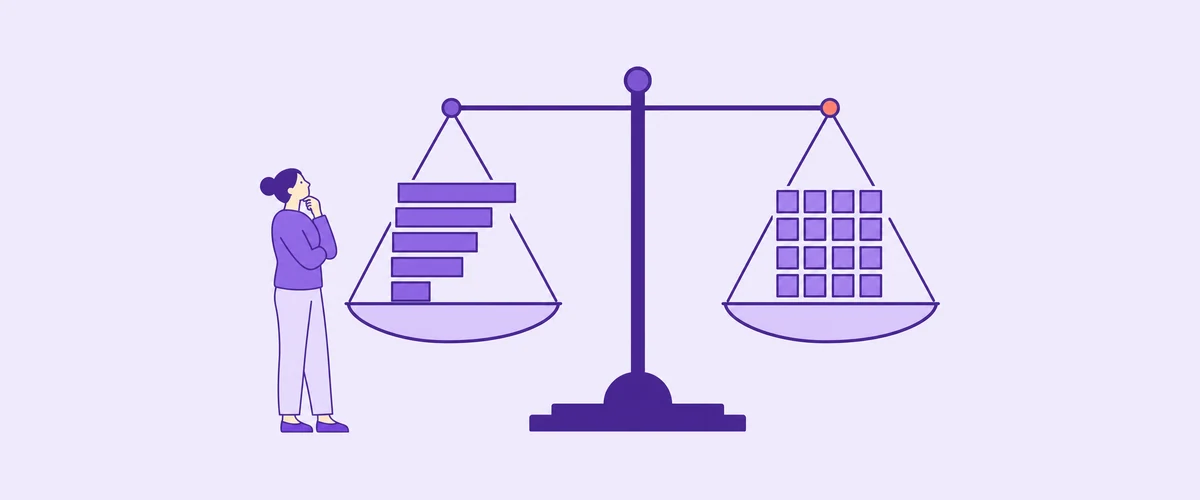
The short answer: The Big Five scores you on five continuous traits and has the strongest research support. Myers-Briggs sorts you into one of sixteen types and is far more popular. If you want evidence, use the Big Five. If you want a shared vocabulary for a team, Myers-Briggs is easier to say out loud.
These two get compared constantly, usually by someone defending the one they took first. They are not really competing on the same field, which is the most useful thing to understand before picking.
What each one measures
| Big Five | Myers-Briggs | |
|---|---|---|
| Output | Five scores | One of sixteen types |
| Shape | Continuous scales | Either-or choices |
| Built for | Research | Self-understanding and teams |
| Covers difficult traits | Yes, including neuroticism | No |
| Retest stability | Good | Poor |
The Big Five measures openness, conscientiousness, extraversion, agreeableness and neuroticism, each as a position on a scale. Myers-Briggs asks four either-or questions and combines the answers into a four-letter code.
The retest problem
This is the finding that does most of the damage. Around half of people who retake the Myers-Briggs get a different type within about five weeks. Nothing about them changed. The instrument did.
The cause is structural rather than sloppy. Forcing a binary choice on a continuous trait means anyone near the middle flips on a good night's sleep. Score fifty-one per cent thinking and you get a T, the same letter as someone at ninety-nine per cent, and a slightly different mood next month makes you an F.
The Big Five avoids this by not asking you to pick a side. Someone at the midpoint of extraversion is recorded as being at the midpoint, which is both accurate and unsatisfying.
The missing trait
Myers-Briggs has no equivalent of neuroticism, the Big Five trait covering how strongly negative emotion lands and how long it stays. That omission is deliberate: the framework was designed to avoid describing anyone in unflattering terms.
It is also the trait with some of the strongest links to real outcomes in wellbeing and relationships. Leaving it out makes the model kinder and less predictive, which is a trade that different people will read differently.
Why Myers-Briggs won anyway
Because "I am an INFJ" is a sentence people can say, remember, and find other people to say it with. "I am one standard deviation above the mean on openness and slightly below on agreeableness" is more accurate and has never started a conversation.
It is used at enormous scale in corporate training for exactly this reason. As a shared vocabulary that gets a team talking about differences without anyone getting insulted, it does a real job. That job is just not measurement. The official description of the sixteen types is worth reading on its own terms.
How to read your Big Five scores
The scores come back as percentiles, which trips people up. Being at the seventieth percentile on conscientiousness does not mean you are seventy per cent conscientious. It means you are more conscientious than seventy per cent of the people in the comparison group.
Three rules make the numbers useful. Read the extremes first, because scores near the middle mean the trait is not doing much to shape your behaviour either way. Read them in combination, because high conscientiousness with low agreeableness behaves nothing like high conscientiousness with high agreeableness. And read neuroticism as a volume dial rather than a verdict: it describes how loudly feelings arrive, not how well you are doing.
None of the five is good or bad on its own. High agreeableness is wonderful in a team and expensive in a negotiation (the same trait, two very different invoices).
Which to use, and when
- Making a decision about yourself? Big Five. It is the one with predictive research behind it.
- Running a team workshop? Myers-Briggs, as long as nobody treats the letters as a fact about anyone.
- Hiring? Neither, on its own. Type-based tools in particular are a poor basis for selection decisions.
- Just curious? Take both. Notice that they disagree, and notice which disagreement you object to. That reaction is often the informative bit.
The Big Five model is the closest thing the field has to a settled answer. It is also, unavoidably, the more boring one.
If you want the short version of all four common frameworks, the guide to personality types lays them out, and the Enneagram comparison covers the other popular contender.
Frequently asked questions
Is the Big Five better than Myers-Briggs?
For measurement, yes. The Big Five uses continuous scales, has strong retest stability and a large research base. Myers-Briggs is better as a shared vocabulary for teams than as an assessment.
Why do I get a different Myers-Briggs result each time?
Because the test forces either-or choices on traits that are really scales. Around half of people get a different type when retested within about five weeks, and anyone scoring near a midpoint can flip easily.
What are the Big Five traits?
Openness, conscientiousness, extraversion, agreeableness and neuroticism. Each is scored as a position on a continuum rather than as a category you belong to.
Does Myers-Briggs measure neuroticism?
No. It has no equivalent trait, by design, because the framework avoids describing people in unflattering terms. That is one reason it predicts less than the Big Five does.
Should employers use either for hiring?
Type-based tools like Myers-Briggs are widely considered unsuitable for selection decisions. Any personality measure used in hiring needs validation for that specific use.
Want the ten-second version first?
Ten seconds, one first name, and nothing to sign up for.
Take the test
Vikram Shetty built TrueTst and this site. He writes about personality tests, why people share the results, and where the line sits between a fun answer and a real assessment. More on the about page.