Can Your Personality Change?
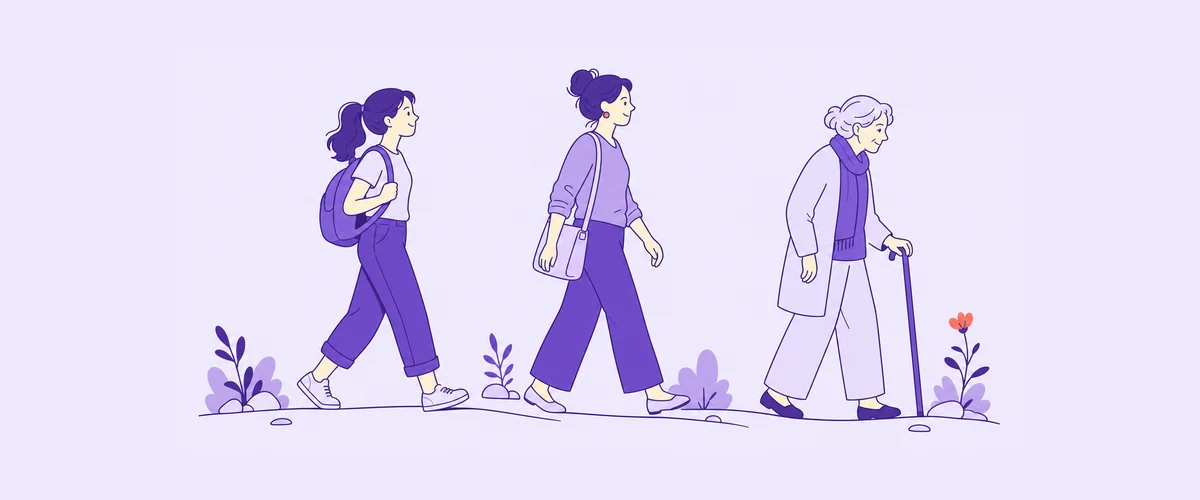
The short answer: Yes. Personality traits shift gradually across adulthood, at roughly a tenth of a standard deviation per decade. Conscientiousness and agreeableness tend to rise with age, while neuroticism, extraversion and openness tend to drift down. Big life events and deliberate effort can both speed it up.
The comforting answer and the useful answer disagree here. The comforting answer is that people can reinvent themselves. The useful answer is that they can, at about the pace a glacier moves, and that this is fast enough to matter over a life.
How much change, and how fast
Longitudinal research puts average trait change at roughly one-tenth of a standard deviation per decade of adulthood. That is small enough to be invisible year to year and large enough that most people are measurably different at fifty from who they were at twenty.
Two things follow from that number. Anyone promising a personality transformation in six weeks is selling something. And anyone who says people never change has not looked at the same person across thirty years.
Which traits move, and which way
- Conscientiousness rises. People get more organised, more reliable and better at finishing things across adulthood. This is the most consistent finding in the area.
- Agreeableness rises. Warmth and cooperativeness tend to increase with age, particularly from midlife.
- Neuroticism falls. Negative emotion lands less hard and clears faster. Most people become more emotionally stable as they get older.
- Extraversion drifts down. Particularly the social-vitality side of it. Fewer, longer conversations.
- Openness falls slowly, usually later than the others and not for everyone.
Psychologists sometimes call this the maturity principle: the average direction of drift is towards being easier to live with. Which is a quietly cheerful finding, and not one you hear much.
What actually drives it
Roles and events do most of the work. The largest shifts cluster around early adulthood and midlife, when people take on responsibilities that require different behaviour: first serious job, first child, caring for a parent, running something.
The mechanism is unglamorous. A role demands a behaviour, the behaviour repeats for long enough to stop being effortful, and eventually it stops being a behaviour and starts being a trait. Nobody decides to become conscientious. They take a job where being disorganised is expensive.
Major events cut both ways. Some, like a stable long-term relationship, are associated with reduced neuroticism. Others push the other direction. Psychology Today's overview of personality change is a reasonable summary of where the evidence sits.
Changing on purpose
There is a real research literature on volitional personality change, and the short version is that it works, modestly, when it targets behaviour rather than identity.
- Pick one trait, not a personality. "More conscientious" is workable. "A different person" is not.
- Convert it into a repeated action. Not "be more organised" but "write tomorrow's three tasks before closing the laptop".
- Make the situation do the work. Traits follow environments more reliably than they follow intentions. Change the room and the habit gets cheaper.
- Measure in months. Trait movement is slow. Judging it weekly guarantees you conclude it did not work.
What does not change much
Rank order is stubborn. If you were more introverted than most of your friends at twenty, you will probably still be more introverted than most of them at sixty, even though you have both moved. Almost everyone drifts in a similar direction, so relative position is remarkably durable.
This is why people say personality is fixed and are half right. Your absolute level changes. Your place in the queue mostly does not (which is also why your family still describes you the way they did at nineteen).
So what does this mean for a type result
Treat any type, from any test, as a snapshot with a date on it rather than a category you belong to. Retake it in five years and expect it to have moved slightly. If it has moved a lot in five weeks, that is the test being unstable rather than you.
If you want the current snapshot, the ten-second version is on the home page. For the frameworks that measure this properly, the guide to personality types covers the Big Five, which is where nearly all of this research is done.
Frequently asked questions
Can your personality actually change?
Yes. Longitudinal studies find trait change of roughly one-tenth of a standard deviation per decade of adulthood, which is invisible year to year but substantial across a lifetime.
Which personality traits change the most with age?
Conscientiousness and agreeableness tend to rise across adulthood, while neuroticism, extraversion and openness tend to decline. The overall pattern is often called the maturity principle.
Can you change your personality on purpose?
To a degree, yes. Research on deliberate personality change finds modest effects when people target specific repeated behaviours rather than trying to change identity, and when they measure progress over months.
What causes personality to change?
New roles and major life events do most of the work: first serious job, parenthood, caregiving, long-term relationships. A role requires a behaviour often enough that the behaviour becomes a trait.
Why do people say personality is fixed?
Because rank order is stable. Almost everyone drifts in the same direction with age, so your position relative to other people changes far less than your absolute level does.

Vikram Shetty built TrueTst and this site. He writes about personality tests, why people share the results, and where the line sits between a fun answer and a real assessment. More on the about page.