Introvert or Extrovert? The One Question That Settles It
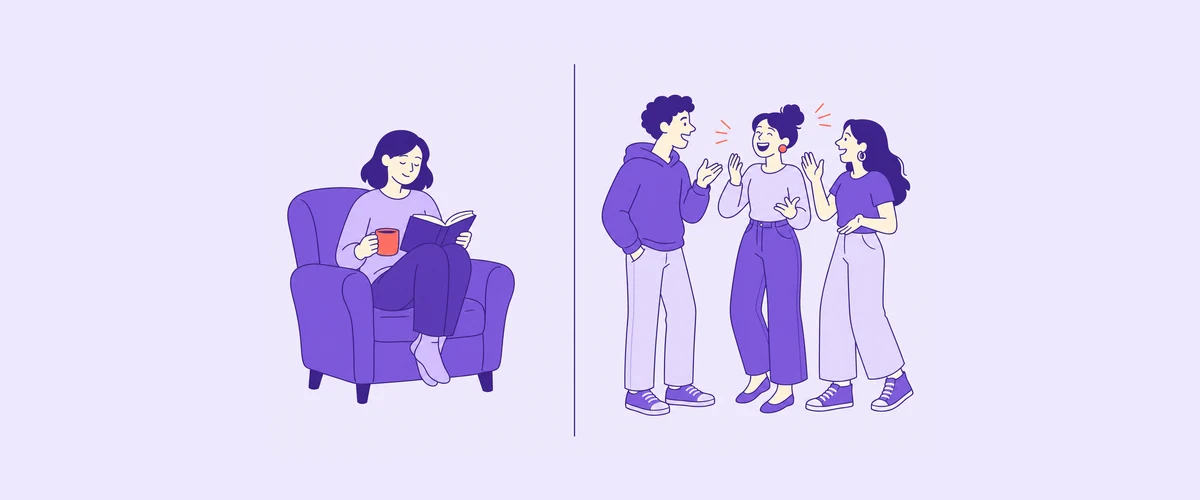
The short answer: Ask yourself one thing: after three hours with people, do you feel charged up or wrung out? Extroverts gain energy from stimulation and other people. Introverts spend it and need quiet to get it back. It is about your battery, not how talkative you are.
Half the people who call themselves introverts are describing shyness. The other half are describing a preference for small groups. Neither is the actual definition, which is why the label gets argued about at every dinner table it appears at.
The real distinction is duller and far more useful.
The question that settles it
It is a Friday. You have spent three hours with people. You are now walking home.
Do you feel lit up and slightly reluctant for it to end, or do you feel like you have been holding something heavy and can finally put it down? That answer is your orientation. Not how much you enjoyed it, not how good you were at it. What it did to your battery.
Extroverts recharge through stimulation and other people. Introverts spend energy on the same activity and need solitude to get it back. Both can be excellent company. Only one of them is being subsidised by the room.
What it is not
- It is not shyness. Shyness is fear of social judgement. Plenty of introverts are entirely comfortable and simply finite. Plenty of extroverts are anxious and still refuel around people.
- It is not being quiet. Some of the most talkative people in any room are introverts who have found their subject and will need a lie down afterwards.
- It is not liking or disliking people. Introverts are not misanthropes on a schedule. The cost is energetic, not emotional.
- It is not fixed at one extreme. Most people sit in the middle, which has its own name.
Most people are in the middle
Extraversion is a continuous trait, not a switch. Score everyone and you get a bell curve with most of the population bunched in the centre, which is where the word ambivert comes from.
Being in the middle is not a cop-out answer. It means your battery behaviour depends on the specific room, the specific people, and how the week before it went. If you have taken this test twice and got different results, you are probably a centre-of-the-curve person who took it on two different Tuesdays.
Where the trait actually comes from
Extraversion is one of the five dimensions in the Big Five model, the framework with the most research support in personality psychology. There it is measured as a score rather than a category, which is closer to how it behaves in real life. The Big Five traits are the reason "somewhat above average on extraversion" is a more honest sentence than "I am an extrovert", and also a much worse thing to put in a dating profile.
Myers-Briggs uses the same word but forces the either-or choice, which is one of the main criticisms of it. Score fifty-one per cent and you get the same letter as someone at ninety-nine per cent.
Ten small signs, five each way
None of these decides it on its own. Read them as a pattern.
Leaning introvert: you draft the message before sending it; you have a favourite spot in any room and it is not the middle; you leave parties without announcing it; you think of the good reply on the walk home; a cancelled plan is occasionally the best news of the week.
Leaning extrovert: you think out loud and find the idea while talking; a quiet weekend leaves you restless rather than restored; you would rather work in a busy cafe than a silent room; you call instead of texting; the last hour of an evening is often your best one.
What to do with the answer
Design your week around your battery instead of apologising for it. If you are an introvert, put recovery time after the big social block rather than hoping you will not need it. If you are an extrovert, stop scheduling your hardest solo work for a day with nothing else in it.
That is genuinely most of the value in knowing. Which is a smaller claim than the quizzes make, and a more useful one (nobody has ever been improved by a label they did not act on).
If you want the ten-second version of the wider question, the type test is on the home page, and the guide to personality types covers where extraversion sits in each framework.
Frequently asked questions
How do I know if I am an introvert or an extrovert?
Ask what three hours of company does to your energy. If you come away charged, you lean extrovert. If you come away needing quiet to recover, you lean introvert. Enjoyment is not the test; recovery is.
Can you be both an introvert and an extrovert?
Yes, and most people are. Extraversion is a continuous trait with the bulk of the population near the middle. People who sit there are often called ambiverts.
Is being an introvert the same as being shy?
No. Shyness is anxiety about social judgement. Introversion is about where your energy comes back from. Confident, sociable introverts are extremely common.
Can an introvert become an extrovert?
Trait scores drift slowly over a lifetime, and extraversion tends to decline modestly with age. You can change behaviour far faster than the underlying trait, which is usually what people mean when they say someone changed.
Which test measures this properly?
A Big Five questionnaire. It scores extraversion on a continuum instead of forcing an either-or choice, which is why researchers prefer it to letter-based type systems.
Want a word for the rest of it?
Ten seconds, one first name, and nothing to sign up for.
Take the test
Vikram Shetty built TrueTst and this site. He writes about personality tests, why people share the results, and where the line sits between a fun answer and a real assessment. More on the about page.